‘More Than a Dog Trainer’
Students
Smith College junior takes inspiration from her own service dog to establish a nonprofit training center

Photo by Jessica Scranton
Published April 21, 2026
Smith’s new mascot is ursine, not canine. Still, it’s fun to speculate: if the mascot had ended up being a dog, what breed would they be?
As Indea Holt ’27 considers the question, she glances down to where her service dog, a rough collie named Laila, is lying calmly at her feet. After a few seconds, she shares her answer with a small smile. “Is it too biased to say rough collie?”
It’s no surprise that the association between Smith and Laila comes easy for Holt: after all, she says, Laila played a significant role in Holt regaining her independence, attending college, and bringing her new nonprofit, Hudson Creek Canines (HCC), to life.
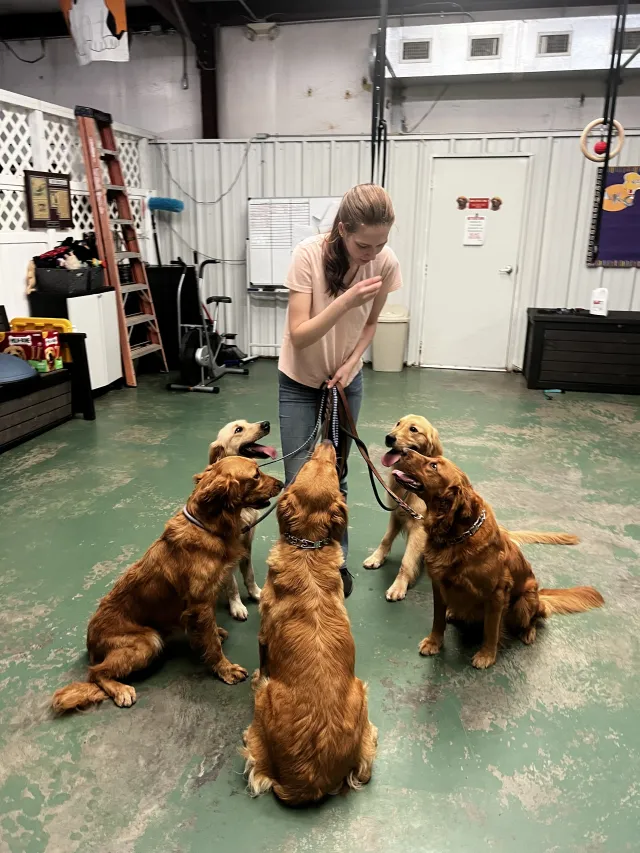
Established in 2024, HCC focuses on dog training and providing psychiatric service dogs at a needs-based cost. The nonprofit’s mission was inspired by Holt’s own struggles in acquiring a service dog for her complex PTSD, which she developed after living with neurologic Lyme disease for much of her adolescence.
As Holt began the long process of searching for psychiatric service dogs with her family, she learned that not only is it difficult and costly to acquire a service dog (as an industry standard, they typically cost anywhere from $20,000 to $30,000, “and that’s on the low end,” Holt adds), but it’s especially rare for psychiatric service dogs to be trained for non-veterans who have mental health conditions.
Holt finally crossed paths with Laila in 2022, when she first connected with Barbara Simpson of Rolling Meadows Academy of Dog Training in North Carolina. Simpson had found Laila through a Craigslist ad posted by a couple looking to rehome her due to a divorce and saw the potential for a great match. Simpson’s intuition was right: Laila has been Holt’s service dog for four years now.
“It was definitely a process, finding her. There was a huge chance that I would never have gotten her,” Holt says. “She’s been such a huge part of my life, my healing, and my journey with disability. I really can’t imagine life without her.”
Holt first began toying with the idea of a nonprofit after over a year of mentorship from Simpson but an encounter with a prospective client who couldn’t afford a service dog of his own soon had Holt accelerating HCC’s goals.
Moved by his story, Holt proceeded to raise $15,000 to help pay for the man’s service dog, and that’s when her ideas for HCC clicked into place.
“I just had this moment of, ‘This is amazing, this is my thing. I want to do this, and be more than a dog trainer. I want to make this happen and be possible [for others],’” Holt recalls. With the assistance and guidance of Simpson, Holt trained the man’s dog, a yellow Labrador named Carly, and successfully placed Carly with him last summer.
“Seeing the process through from day one to delivery and now getting updates from him, it was just one of the most powerful experiences I’ve had in my life,” Holt says. “Carly went on her first trip to Comic-Con, and her owner tells me that she’s just really changed his life. They’re just doing amazing together.”

Carly (left) and Laila sporting their Hudson Creek Canines vests. Photo courtesy Indea Holt.
With HCC, Holt takes a different approach from other programs, which usually breed their own puppies for training. Instead, she connects with one- to three-year-old rescue dogs who need to be rehomed. She learns their personalities and backgrounds to determine whether or not they could be suited for training and eventual work as a service dog.
While Holt does her best to train potential service dogs successfully, not all dogs end up in that role. The risk doesn’t deter Holt: dogs who don’t have a future as service dogs are adopted as pets. They get a loving home, and the funds from their adoption fees go toward supporting service dogs still in training at HCC.
The dogs aren’t the only ones learning and growing during their time at HCC: Holt is too. She’s overseeing renovations for HCC’s physical training space in Rhinebeck, New York (during the academic year, most of her training work is done virtually, but whenever she’s able, Holt also travels to clients’ homes or public spaces for in-person trainings). She also recently secured a summer internship with the University of Pennsylvania’s Penn Vet Working Dog Center, and is starting to plan fundraising efforts so she can fully immerse herself in HCC after her graduation next year.
“Training programs take a long time to develop, and I’m very much still in my educational years,” Holt says. “I’ve done a lot so far, but I know I still have so much to learn. I know I want to pursue Hudson Creek Canines, though, and I know what goes into that is education.”